Research EEG system — FLEX
Up to 32 channels of research-grade EEG: gel or saline sensors. Official Emotiv supplier in Russia: configuration selection, training, and support in Russian.
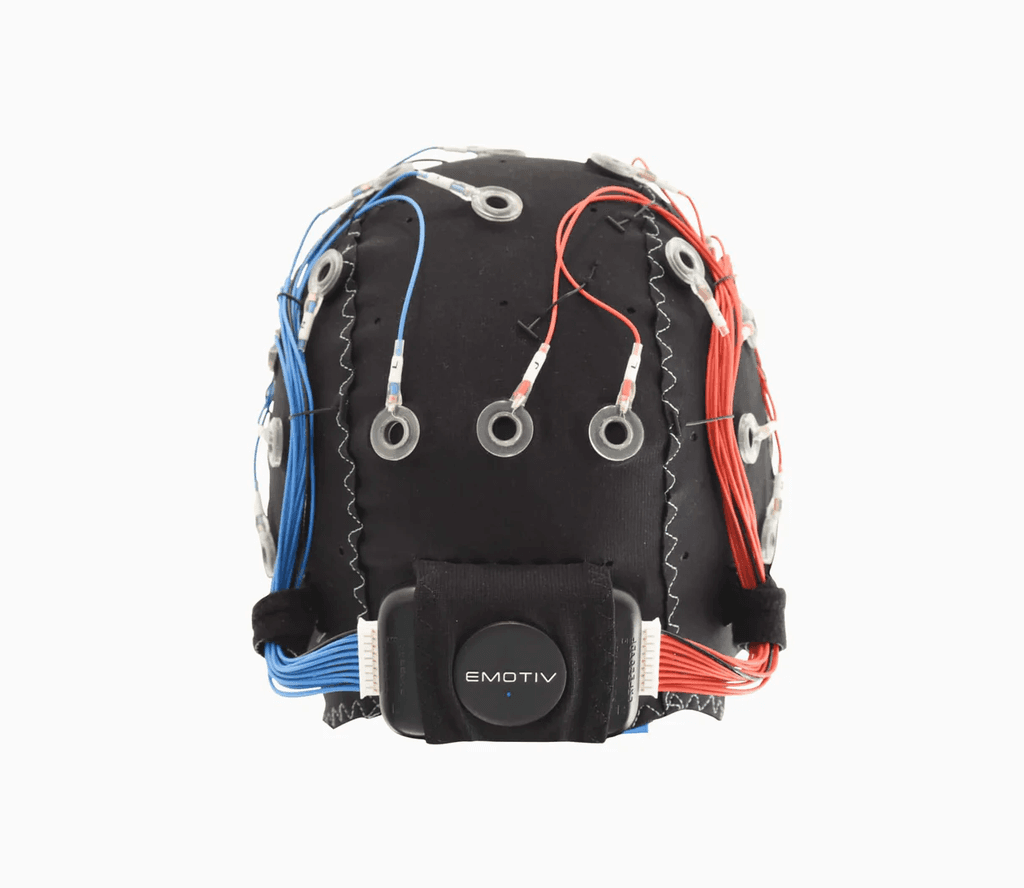
FLEX overview: key features
FLEX is Emotiv's flagship research system for laboratories that require full setup and maximum flexibility. Up to 32 recording electrodes are placed in any positions according to the 10–20 system for the specific research protocol, and two references are set on the mastoids or any 10–20 point (compatible ear clips are included). Two sensor versions are available: classic gel for maximum signal quality and saline for quick setup without gel.
The heart of the system is the Flex Controller 2.0 with dual ADC: 2048 Hz sampling rate with 256 SPS output, 16-bit resolution (1 LSB = 0.51 μV), and a bandwidth of 0.16–43 Hz. A unique feature of FLEX is time-synchronized recording not only of EEG but also ECG, EMG, and EOG: one device covers multimodal protocols in psychophysiology, biocontrol, and autonomic nervous system research. Data transmission is via a proprietary 2.4 GHz USB receiver or Bluetooth 5.2, with wired USB support through Emotiv Extender.
Six reasons to choose FLEX
Each feature translates to a specific benefit for your project: from participant preparation speed to data quality and total cost of ownership.
Customizable mounting for protocol
32 electrodes in any 10–20 positions: standard 10–20 montage, high-density areas, or reduced schemes—configuration for the task instead of compromise. References—where methodology requires.
Gel or saline sensors — your choice
Gel electrodes provide minimal impedance for demanding ERP protocols; saline electrodes offer quick setup without gel for field sessions. One system covers both scenarios with interchangeable sensors and caps.
Synchronous EEG + ECG + EMG + EOG
Time-locked signal registration in one device: heart rate, muscle activity, and eye movements are synchronized with the brain signal—without external synchronizers and manual timing adjustments.
Dual ADC and honest 16 bits
Parallel digitization with two ADCs eliminates channel skew: 2048 Hz internal, 256 SPS output, LSB 0.51 μV, 0.16–43 Hz band with 50/60 Hz notch filters—laboratory-grade data.
Dual data transmission channel
Official 2.4 GHz USB receiver included plus Bluetooth 5.2 with enhanced real-time transmission; for stationary setups — wired USB 2.0+ via Emotiv Extender.
6 hours and battery monitoring
595 mAh battery holds up to 6 hours of recording, and the controller indicator shows charge level before the session — planning the experimental day without surprises.
FLEX use cases
Full-cycle laboratory research
ERP, spectral analysis, connectivity analysis — full 10–20 montage with gel or saline electrodes as chosen.
Neurobiocontrol (neurofeedback)
Multichannel real-time signal for attention, relaxation, and rehabilitation training protocols.
Multimodal psychophysiology
Joint analysis of EEG, ECG, EMG, and EOG: autonomic responses, emotions, cognitive load, sleep and wakefulness.
BCI research and competitions
A classic platform for neurointerface projects: many channels, precise timing, open API.
Clinical and applied R&D
Research in neurology, psychiatry, and pharmacology within research protocols (not for medical diagnostics).
FLEX in detail
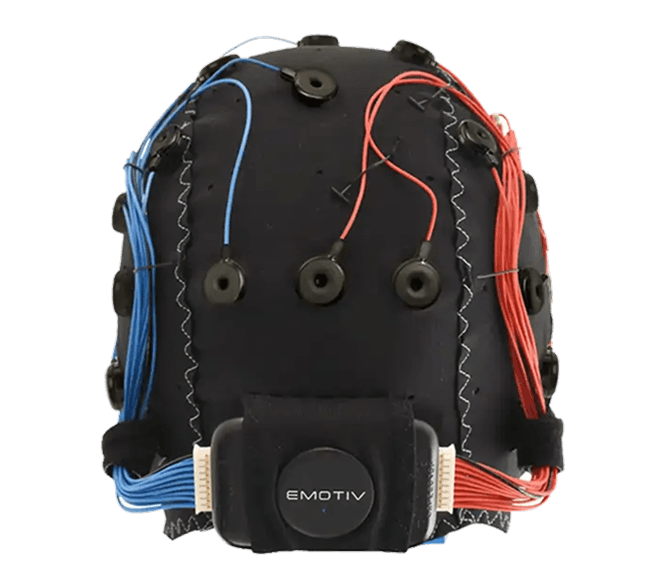
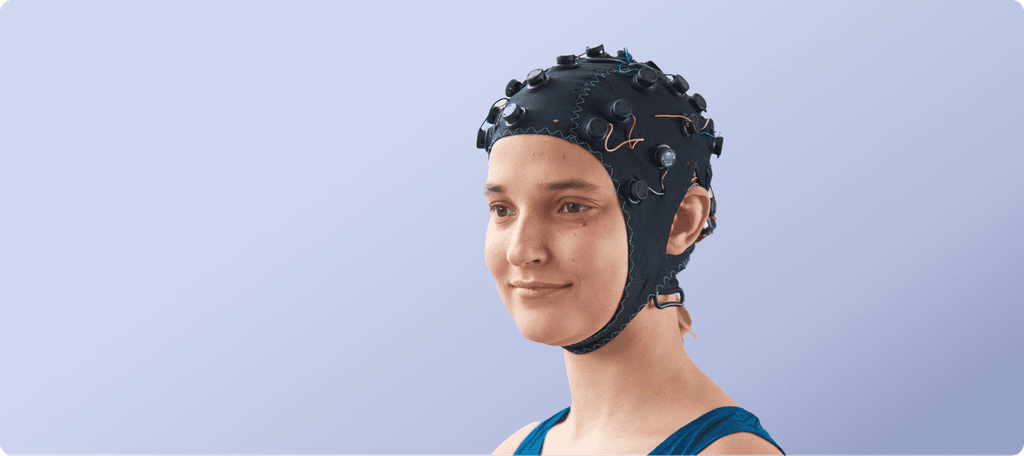
FLEX technical specifications
| EEG channels | up to 32 recording + 2 reference channels (CMS/DRL, configurable) |
|---|---|
| Mounting | any 10–20 positions; ear clips for references included |
| Sensor versions | gel (Flex Gel) or saline (Flex Saline); felt pads 11 mm |
| Felt kit | 80 standard length + 20 extended |
| Sampling method | serial, dual ADC |
| Sampling rate | internal 2048 Hz → 256 SPS output |
| Resolution | 16 bits, 1 LSB = 0.51 µV |
| Frequency band | 0.16–43 Hz; notch filters at 50 and 60 Hz |
| Dynamic range | 8400 µV (peak-to-peak, input); AC coupling |
| Synchronous signals | time-locked EEG, ECG, EMG and EOG |
| Connection | proprietary 2.4 GHz USB receiver (included); Bluetooth 5.2; USB 2.0+ via Emotiv Extender |
| Power | USB-C for charging (cable included) |
| Motion sensor | IMU ICM-20948: quaternions, accelerometer ±8g, magnetometer ±12 gauss, stream up to 64 Hz |
| Battery | lithium-polymer, 595 mAh |
| Battery life | Up to 6 hours, charge indicator on controller |
| License | raw EEG requires an EmotivPRO license |
Software and integrations for FLEX
The headset works within the Emotiv ecosystem: from ready mobile applications to open API for custom developments.
EmotivPRO (PRO License)
A mandatory license is required to work with raw EEG FLEX: recording, experiments, exporting data for analysis.
Cortex API / SDK
Software access to 32 channels in real time for neurofeedback, BCI, and integrations.
Emotiv Extender (optional)
Wired USB mode and extended stationary installation scenarios.
FLEX in the context of the Emotiv product line
Compare models by channels, sensors, and battery life — or call us, and we'll select a device for your task in 10 minutes.
| Model | Format | Channels | Sensors | Sampling rate | Battery life | Main tasks |
|---|---|---|---|---|---|---|
| MN8 | EEG in-ear earbuds | 2 | Dry, in-ear | internal 256 Hz | up to 6 h | Wellness and mobile applications |
| Insight | Headset headband | 5 | Semi-dry polymer | 128 Hz | up to 20 h | Development, education, BCI prototypes |
| EPOC X | 10–20 cap | 14 | Salt-felt | 128/256 Hz | up to 9 h | Applied research, neuromarketing |
| EPOC X PRO | 10–20 cap | 16 | Dry, active amplifiers | 128/256/512 Hz | workday + 8 hours memory | Next-generation research, field EEG |
| FLEX | Cap + controller | up to 32 | Gel or saline | 256 Hz | up to 6 h | Labs, neurofeedback, multimodal protocols |
FLEX frequently asked questions
FLEX — is this a gel or saline system?
How many channels are actually available and can fewer be used?
What does 'synchronous recording of EEG, ECG, EMG and EOG' mean?
What is the sampling rate and is it sufficient for ERP?
Is special software required?
How to buy FLEX in Russia and what about consumables?
Ready to implement FLEX?
We'll send a quote with prices, delivery times, and software configuration for your task — within one business day.